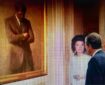
Nancy Reagan and Jackie Kennedy Onassis both inscribed for me this picture of their meeting. (Please do not copy to Pinterest or other curating sites.)
“What about Jackie?”
The first person Nancy Reagan asked me about was Jacqueline Kennedy Onassis.

Inside Marine One, the presidential helicopter.
I’d never flown in a helicopter before, let alone the presidential one, but there I was in the sky, whirring through the lower stratosphere above a landscape of ancient Virginia forests being rapidly consumed into suburban housing developments. The chopper was headed to a large clearing of land known as Camp A.P. Hill, near Bowling Green.
This was not just any whirlybird, however, nor a day of knot-tying contests. It was Marine One, the presidential helicopter on its way to the annual Boy Scouts Jamboree, a massive gathering of scouts that were waiting for a speech from the President of the United States that would be delivered by – the First Lady of the United States.

Mrs. Reagan visiting her husband as he recuperates in Bethesda Naval Hospital, July 1985.
At that moment, Ronald Reagan was still recuperating at Bethesda Naval Hospital, following colon cancer surgery. In a dramatic shift that signaled a new level of public confidence, Nancy Reagan decided to assume more presidential duties until her husband was able to resume his schedule. She decided that she would give the speech expected of him.
I had only recently been brought on, in a contracted position, to write the First Lady’s speeches. It came about as a response to a request for an interview with her that I had submitted to her Chief of Staff James Rosebush, to be used in the book I had already begun researching on the political power of First Ladies.

On the helicopter, Mrs. Reagan’s eyes were on me as I spoke – carefully.
Rather than one sit-down interview, he suggested I might observe the First Lady both in public and behind-the-scenes, asking her questions along the way. From his point of view, I could provide prepared remarks for her to rely upon as she ascended platforms and faced her audiences from podiums. While she had begun to make longer and more serious speeches, at that point, four and a half years into her tenure as First Lady, she really didn’t need speech cards except to make reference to statistics or names, having become expert at studying the audience and addressing them more extemporaneously.
Several members of her senior staff were also there and after they’d conferred with her briefly, I was introduced. She gave a big sigh, and bit of a giggle, beamed a smile and looked directly at me.
“The political power of First Ladies,” she remarked with skepticism, “You think about Eleanor Roosevelt and Abigail Adams, but were there really many others like that?” She nodded, as if to prompt me.

Ronald and Nancy Reagan confer with Mamie Eisenhower.
I launched into my premise that all of her predecessors had exercised different types of power in varying degrees and while most hadn’t initiated policy, they influenced the presidencies of their husbands. To emphasize my point, I focused on obscure ones. Peggy Taylor influenced the choice of Attorney General. Ida McKinley urged retaining the Philippines after the Spanish-American War. Julia Tyler lobbied for Texas annexation. Mrs. Reagan remained quiet, studying my face.
“Well, but even recently?” she asked politely, then again fell silent. Mamie Eisenhower helped distance the Administration from Senator McCarthy at the time of his controversial hearings. Bess Truman advised her husband to drop the second atomic bomb.

Mrs. Carter, Mrs. Reagan: different types of power.
And there was the woman she had replaced when her husband defeated the incumbent President’s bid for re-election. “Mrs. Carter of course was so involved…–” Mrs. Reagan gave a quick, formal smile – and I stopped from detailing Rosalynn Carter’s power. “– in so many things.”
“What about Jackie?” she just blurted out.
I had only recently interviewed JFK staff member, including Arthur Schlesinger and Ken Galbraith about her political sensibilities and gifts – so I told her something I’d recently learned.

JFK with Khrushchev in Vienna – and the Soviet Politboro behind him, including Andrei Gromyko, speaking to Secretary of State Dean Acheson.
When Jackie Kennedy first met Khrushchev, the night after he conferred with President Kennedy in Vienna, she would glance over his shoulders to briefly scrutinize members of the Soviet Politburo.
Mrs. Kennedy had studied the State Department briefing book beforehand and was able to match their names to their faces. Then she had a chance to meet them individually. She made small talk and asked them all questions based on their biographies she’d read in the briefing book. And then she reported her assessment on them all back to the President.

Two American First Ladies with two Soviet leaders
“Gromyko is the only honest one who can be trusted,” Jackie told Jack.
Mrs. Reagan’s big brown eyes got even bigger: “Boy! Nobody knew that about her at the time. It was never reported!” (I would wonder if she remembered this when she first met Soviet president Mikhail Gorbachev several months later).
“Yes,” I smiled. “it seems the President told people. I got it from Schlesinger. She never told anyone and didn’t want it known.”
The helicopter was beginning to descend. She slyly smiled and leaned in as if to suggest some sort of classified First Lady secret.
“That’s why,” Nancy Reagan quipped, “she had the power!”

I didn’t want to read too much into her question or her response, but during that particular period, Jackie Kennedy Onassis was on the radar of Nancy Reagan. Just one month earlier, On June 26, 1985, they had met for the first time. And one month later, they would meet for a second, and final time. The two First Ladies, however, had begun speaking together on the telephone two months after the Reagan Administration had began.

The Kennedy Inaugural cape and the Reagan one.
It was actually on day one, when Nancy Reagan had become First Lady, January 20, 1981, that it became visibly obvious just which of her predecessors she would be emulating.
When Nancy Reagan emerged on the arm of her husband, the new President, to make their way to the first of several Inaugural Balls, she swept out the door draped in a dramatic white cape, covering her bead-encrusted gown.
It was exactly what Jacqueline Kennedy had worn to her husband’s Inauguration, over her gown, with a bead-encrusted bodice.

Sinatra escorts two First Ladies into the Inaugural Gala: Nancy Reagan, 1985, and Jackie Kennedy, 1961.
To advise her on White House protocol and entertaining form, Mrs. Reagan had already called in Letitia Baldrige, who had served as Jackie Kennedy’s Social Secretary.
She wanted things, recalled Baldrige, “Just like Jackie.”
And Nancy Reagan was escorted into the Inaugural Gala by a man she ardently admired. He had produced the entire show for the Reagans.
He’d done the same thing for the Kennedys, and escorted Jackie into her husband’s gala. It was Frank Sinatra.

Nancy Reagan was criticized not for the style of her clothing but her acceptance of them as loans – which became gifts. Jackie Kennedy’s father-in-law underwrote the great expense of hers.
In the first year of her tenure as First Lady, however, Nancy Reagan was unmercifully attacked in the press for beginning her tenure, a time of high unemployment and economic recession, by focusing on her day and evening clothes, new state china, refurnishing both the public and private White House rooms. It made her appear insensitive to what the public was experiencing.
Friends of Mrs. Reagan implied that she only did what Jackie had done, but where she was attacked, Mrs. Kennedy had been praised. Many supporters declared it was a partisan attack, and that the media had a love affair with the Kennedys and protected them. Unfortunately that argument ignored many differences.
Mrs. Kennedy’s expensive clothing was paid for by her father-in-law and furthermore, she had a hand in the design of certain gowns, intended to mirror the purposes of her appearances.

Ladies in red: Nancy Reagan and Jackie Kennedy in their favorite room.
Mrs. Reagan was criticized not for the style of her clothes but the fact that she had accepted them as “loans,” and then donated the items to museums which then, legally, made them “gifts” (one could not give away what was merely loaned).
And most importantly, Jacqueline Kennedy had conducted an overall historical “restoration” of the White House state floor, after conducting assiduous research about its appearance in the early 19th century presidencies. She sought specific historical objects, then helped author an historical guidebook, created an historical association and the position of curator.
None of the First Ladies during the ensuring years, including Nancy Reagan, redecorated the rooms with history so passionately as their guide.


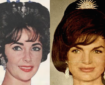
Jackie and Nancy in their pinks.
It wasn’t long into Ronald Reagan’s tenure as Governor of California that the press first noticed something about familiar about his wife.
She wore the bright colors on her slim figure in a manner that seemed to evoke someone who, despite being out of the White House for three years at that point, was still instantly recognizable not just by her face but by her clothes.

Jackie and Nancy in their winter white.
Soon enough, magazine and newspaper profiles about Mrs. Reagan began referring to her California’s Mrs. Kennedy. Look Magazine dubbed her “a Republican version of Jacqueline Kennedy” with her “same spare figure, same air of immaculate chic.”
Even the way they stood while listening to speeches, holding their hands clasped in front of them seemed worthy of note. It’s impossible to trace whether or not the presidential widow’s style was consciously copied by the gubernatorial wife. The Kennedy look was still so ubiquitous in the mid-Sixties that it would be equally impossible to say it did not. It seemed to influence every American woman at the time.

Jackie and Nancy, wearing of the green.
Like millions of others around the world, Nancy Reagan became riveted by Jackie Kennedy when John F. Kennedy was first campaigning for the presidency, despite the fact that her husband was chairman of “Democrats for Nixon.” Even though Ronald Reagan would begin to publicly criticize the medicaid program initiated by the Kennedy Administration and its support to end school prayer, is wife’s interest in Mrs. Kennedy only increased after the inauguration.
Amelia Gray, the owner of a tony Beverly Hills dress shop frequented by Nancy Reagan recalled that she “often talked about Jackie and the style and the grace.”

Jackie and Nancy standing and clasping alike.
And perhaps there was some projection about being in her shoes. “Not a day goes by,” Nancy Reagan wrote a friend in 1962, when someone doesn’t come to the house and ask Ronnie to run for senator or governor or even President. It boggles the mind but maybe it’ll get me out of the carpool.”
They both had an interest in the traditional purview of the elite class at that time, with an emphasis on “taste” in furnishing their homes and entertaining guests. They had several of the same acquaintances. Although she became a dedicated Democrat, Kennedy’s father had been as rabid a Republican and the reverse was true with Republican Reagan, who’s mother was a lifelong Democrat. And both Mrs. Kennedy and Mrs. Reagan had an older daughter and younger son. There, however, the similarities really ended.
Until Nancy Reagan became First Lady in January of 1981. At that point, she had six living predecessors but was not particularly close to any of them.

Nancy Reagan with four of her six predecessors alive at the time she became First Lady: Carter, Ford, Nixon, Johnson.
Bess Truman would die a year after and was already 96 years old. Mrs. Johnson, Mrs. Ford and Mrs. Carter were, at the time, all advocating for passage of the Equal Rights Amendment, which Mrs. Reagan had stated in the previous, campaign year, strongly opposed. All three were decidedly liberal in their political perspective, in counterpoint to the views of the man who had just been elected president on a conservative agenda. And his wife.
It was just Pat Nixon, frail and never to once return to the White House, who offered advice to the new First Lady on how to handle the job. Her only suggestion was to make as much use as possible of Camp David as a genuine escape from the pressures of living in the executive mansion.

Nancy Reagan arriving at George Washington University to see her husband as soon as she learned of the shooting. (carlanthonyonline.com)
Then came March 30, 1981. In just a little bit over two months after becoming First Lady, Nancy Reagan was confronted with the very real possibility that she would soon be leaving it under the darkest of circumstances. There had been an assassination attempt on his life and he had to remain hospitalized to ensure his recovery.
The terror of Ronnie being in imminent danger of death instantly made her distraught beyond anything she had ever experienced and broken immediately in spirit. She went immediately to him at George Washington University Hospital and made sure she appeared strong – for him.

Nancy on the sofa, West Sitting Hall 1981.
Living alone in their new home, overwhelmed with fear of Ronnie not recovering or, if he did, then fear of another such attempt on his life, Nancy Reagan was startled by the morning mail that had been screen and sent up to her suite at the White House, after opening a small, pale-blue envelope with a return address of 1040 Fifth Avenue. Just after lunch that day, she received a phone call also from New York. Both were from Jacqueline Kennedy Onassis.

Jackie on the sofa, West Sitting Hall, 1961.
As Mrs. Reagan recalled, “She was very kind to me when my husband was shot, and we didn’t know whether he was going to live….She wrote a very sweet, sensitive note and called me. She couldn’t have been nicer at a time when I really needed it.”
Respecting her privacy, Mrs. Reagan never made the contents of Mrs. Onassis’s note public.
Mrs. Onassis gave Mrs. Reagan a phone number she could use if she ever wished to call on her. And once or twice in that first year, she did – especially after the attacks on her for doing what Jackie Kennedy had done as First Lady

J.B. West with Jackie Kennedy and her son John the morning that they moved out of the White House.
There was another call that came thru to Mrs. Reagan in 1982 from Mrs. Onassis. Among the few people that Jackie had been close to when living in the White House with whom she had remained steadfast friends was J.B. West, the former Chief Usher.
Learning of his death, the former First Lady remembered how he had hoped to be buried in Arlington National Cemetery.
Only members of the military had that privilege, unless the President of the United States interceded. Jackie called Nancy, Nancy talked to Ronnie and “Mr. West,” as Mrs. Onassis always called him, was buried in Arlington. Within a matter of minutes, it was all arranged, “First Lady to First Lady,” as Mrs. Reagan remarked at the time.
Despite their political differences, the Reagans and the Kennedy family had formed a bit of a bond. They invited Rose Kennedy to visit the White House for the first time since her son’s presidency.

Ethel Kennedy, far left, with the Reagans after the Rose Garden ceremony they hosted honoring her late husband.
When the President learned that the late U.S. Senator and Attorney General Robert F. Kennedy had been chosen by Congress to receive its gold medal during the Carter Administration but that the acrimony between Jimmy Carter and Teddy Kennedy meant the award was never presented to his family, he remedied that.
On June 6, 1981, the Reagans presented the medal in a Rose Garden ceremony to his widow Ethel. Present were all of their children, as well as all of the living siblings of RFK and JFK, Teddy Kennedy, Jean Smith, Pat Lawford and Eunice Shriver.

John Kennedy, Jr. and his mother Jacqueline Kennedy Onassis welcome Ronald and Nancy Reagan to the June 1985 fundraising event.
Five months later, the Reagans invited the late president’s mother back to visit the White House for the first time since her son had lived there.
Despite the Kennedy family working as a united front to back the 1984 Democratic presidential candidate Walter Mondale against Reagan in his bid for a second term, that same year the late president’s children John and Caroline came to the Oval Office to meet with him.
They explained that unlike all the other presidential libraries, the one where their father’s items and papers were gathered, the John F. Kennedy Presidential Library and Museum, only dedicated in five years earlier, did not have an endowment.

Gathered in Teddy Kennedy’s living and posing before the fundraising dinner are Kennedy, Ronald Reagan, Nancy Reagan, Jacqueline Kennedy Onassis, Ethel Kennedy, Caroline Kennedy and John Kennedy, Jr.
They were planning a fundraiser that next year, on the property of Senator Kennedy. Without hesitation, Reagan agreed to speak.
So, on June 26, 1985, Nancy Reagan had the chance to meet and speak with Jacqueline Kennedy Onassis in person for the first time.
It was not exactly a joyous event, nor entirely sad. As many of her friends recalled, Mrs. Onassis always retained a certain fragility that had resulted from the trauma of the assassination. Although she would come to Washington many times after she had left, it was never without a certain degree of discomfort. Smiling, she was nevertheless subdued. Some of the pictures showed Mrs. Reagan smiling at her almost worshipfully. She readily admitted to being “in awe” of Mrs. Onassis.

The two First Ladies talk, while the President smiles beside them.
At the dinner, all of the late President’s living siblings were again in attendance, as were Eunice Shriver, Pat Lawford, Jean Smith and U.S. Senator Edward Kennedy. The event was held on the lawn of his home, beneath a white tent. For the dinner menu, Jackie Onassis chose two particular favorites of Nancy Reagan, salmon and veal.
As the President spoke about President Kennedy, a Washington Post reporter described Mrs. Onassis as being somewhat transfixed, her eyes never leaving his figure, her facial expression “contemplative and somber.” Here is a videotape of the event and President Reagan’s especially eloquent words:
According to Reagan aide Michael Deaver, the two First Ladies never became “soul sisters,” but Nancy was “touched” by the way Jackie encouraged her to chart her own course, and ignore the criticism- especially since the second election had been won.
“You’re going to be there a long time; you might as well get used to it,” she told her.

Jacqueline Kennedy’s White House portrait by Aaron Shikler.

Nancy Reagan’s White House portrait by Aaron Shikler.
A month later, Mrs. Reagan did indeed ignore the critics.
With her husband’s life again on the line, with the threat of cancer, she seized control of the situation, not only charting the course for his convalescence from the surgery, but limiting his schedule, refusing permission to important officials from holding meetings with him in the hospital until a certain point, directing that Vice President George Bush check in with her before doing anything that might appear to usurp the presidency and having her first showdown with Chief of Staff Don Regan, refusing him the right to continue using Marine One.
So, it was a different Nancy Reagan who saw Jackie Kennedy Onassis before the end of the summer, enjoying a few days as an overnight guest of her friend Katherine Graham, at her Martha’s Vineyard home, along with Mike Deaver as her escort.

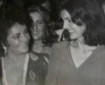
Jackie Kennedy with Katharine Graham (left) and Nancy Reagan with her. (right).
Mrs. Reagan recalled getting up the nerve to urge her predecessor to come back to the White House for a visit, to show her the way she had refurnished the rooms. Mrs. Onassis, Nancy Reagan wrote in her diary, “prefers not to return to Washington, but if she changes her mind, she’ll let me know.”
Except for a visit and dinner of three and a half hours with the Nixons in February of 1971, intended to show her children their old home and view the portraits of herself and the late president, Jacqueline Kennedy Onassis never did return to the White House.

Jackie Kennedy Onassis and Nancy Reagan have a personal word with one another.
Nine years after their only two meetings, in May of 1994, Jacqueline Kennedy Onassis died. Five months later, Mrs. Reagan reflected on her bond with her in an interview with me: “When we came home from the hospital…there was a picture of us in the paper, coming back to the White House. We talked again. And then, at times when she knew it was a little rough, she’d call. She was very sensitive to my feelings. At the time Ronnie was shot, I needed someone to be.”
One month later, it was announced that Ronald Reagan was in the early stages of Altzheimers
There can be no definitive answer, of course, only speculation to the question of what would have happened to Nancy Reagan if March 30, 1981 had ended tragically, if she had been left widowed two months into her husband’s presidency, at only fifty-nine years old.
In light of the strength she summoned and sustained to work for a decade as her husband’s primary caretaker while he descended into the shadows, it seems that she may have managed to do so for decades on her own, however sadly she would have gone on without him. There would have been one other person who could understand.
And if Nancy had not reached out to Jackie, it would seem Jackie would have reached out to her.
Categories: The Kennedys, The Reagans
Private Pools of the Presidents: A Photo Essay
First Ladies, Swimsuit Edition: Bikinis to Bonnets to Bloomers
The Presidents, Swimsuit Edition: Trunks to Tees to Plain Naked
White House Staff Reveal Private Life of Presidents & First Ladies
Carl,
What a warm and touching story! I have come to rely on you as the guru of first ladies! While others may embellish or even fabricate stories regarding Mrs Onassis or other first ladies, you always stick to the facts, Thank you for that!
Barbara
Thanks Barbara – and I apologize for the delayed response. The fact of the matter is that if one does very intense research and for a period of years one finds far more fascinating anecdotes and remarks made by these people than could ever be fabricated.