Twenty years ago today, one of the 20th century’s most legendary Americans and perhaps the world’s most iconic woman died.
Despite dying just two months shy before qualifying for Social Security benefits, Jacqueline Bouvier Kennedy Onassis’s associative identification in the public imagination with an era which had ended thirty years earlier had so permanently affixed itself onto her that it eclipsed the perception of her even as a real person. Or, as her second child and only son John Kennedy expressed it when previewing the magazine George which he co-founded:
“As a lifelong spectator of the giant puppet show that can turn public people into barely recognizable symbols of themselves, I hope we can provide something more useful.”

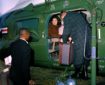
In front of the home they shared, John Kennedy announces to the world the death of his mother, the morning after she died on May 19, 1993. (AP)
There was thus nobody more understanding of that nexus between her public and private personae than he and none more sensitive to her own nuanced self.
And thus, there was none more appropriate than he to announce to the world her death on May 19, 1994 in a statement that was, like her, simultaneously vague and specific:
“Last night, at around 10:15, my mother passed on. She was surrounded by her friends and family and her books and the people and the things that she loved. And she did it in her own way, and we all feel lucky for that, and now she’s in God’s hands.”

The President and Mrs. Kennedy united with their children on their way to the White House together for the first time, February 1961.
They were unusually close for a mother and son, understandable given the circumstances of his maturing into an adult without a father.
Only the first three years of his life were spent with his father, but another thirty would be spent with Jackie as his only parent.
She shared one decade of life with Jack, but three with John.
And while his father’s name strongly identified him, his mother’s thinking thoroughly influenced him.
She was not the perfect mother which the public insistently imagined her to be.
John often remarked that she could be too exacting and at other times, early on, was absent when he felt he needed her, even remote. If anything, that made her all the more a typical mother, working to do her best but being humanly imperfect. There were times, he later confessed, when “Jackie O” was a confounding riddle even to him. And when speaking of her public persona, he referenced it as “Jackie O.”

President Kennedy driving his wife and son.
Given the unique circumstances of her not having a husband yet there being Secret Service agents to protect and transport the family and domestic help to cook and clean for them, Jackie Kennedy Onassis was afforded the time and attention to express her maternal devotion through conscientiously inculcating her values and sharing intellectual pursuits with her children.
She engaged with John in a way which developed his curiosity for her interests but also exposed her to his interests about which she had previously known nothing. They shared a love of live theater. She got him into writing. He got her into kayaking.

The First Lady with her children just nine months after they entered the White House.
While concerned about the psychological affect on both of her children as being the presidential children, the age difference between Caroline and John Kennedy could not help but be a significant factor: the most crucial period of early childhood development is infancy to three years old, coinciding exactly with his age in the White House while his sister was already three years old when their tenure there began. This also explains Jackie’s more intense focus on John: he was highly vulnerable.

Two days after President Kennedy’s assassination, Jacqueline Kennedy and her son ride to the U.S. Capitol where JFK’s coffin was laying in state, sharing a limousine with the new President and Mrs. Johnson.
His impulse to be exuberantly carefree and entirely trustful of strangers was likely influenced by the fact that he’d not been old enough to fully comprehend and become traumatized by his father’s murder (his sister carried a far greater brunt of this); Jackie Kennedy was determined not to develop a mournful home atmosphere which would impinge that quality in him.
Jackie Kennedy was as much a disciplinarian on regulation of behavior as her own mother had been with her but radically departed from the way she was raised by openly expressing her emotional attachment to her children, making no distinction between them based on gender.
One is struck by the evidence of this in so many pictures of them snapped in public. Even as John matured from toddler into adolescence, he and his mother spontaneously embraced and kissed. Except with Teddy Kennedy at public events towards the end of her life, Jackie Onassis simply did not do this publicly even with others she loved.

Highly protective of John, Jackie Kennedy shielded his head with her hands during a media gauntlet the day before she married Onassis.
The president’s widow seemed especially protective of him physically as well, taking his hand and guiding him through crowds, touching his back to steer him in one direction, holding his arm to prevent him from going in another. She didn’t have the need to do that with her more self-assured daughter.
Numerous pictures also reveal her flashing a unique signal to her son as he matured, in the way of a beaming smile with eyes seeming to telegraph both love and humor, as if on the verge of busting a laugh.
And while she instilled in him a decorum which included showing respect for all people regardless of their station in life, she also encouraged him to indulge his antics, to be free of the self-consciousness with which she herself was still often plagued. Somehow that seemed to help her for she fueled his creative, sometimes zany, imagination by also letting him see her own. They’d both had a penchant for prep-school pranks.
Performed with more eagerness than he appreciated, she chaperoned school trips, attended P.T.A. meetings, asked to meet his pals, and confronted him about what that was that she found in his pants pockets. The suburban housewives who had copied her clothes and coiffs a decade before could hardly realize that the Fifth Avenue icon was copying them. But among the many hats she wore, Jackie was a Late Sixties Mad Men Mom, remembering to pick up refills of his prankster favorites Crazy Foam and Silly String at a Lexington Avenue toy store, or his top snack foods Whistles and Daisies at Gristedes.
While foremost a parent to her children, she developed independent friendships with them each. When he inherited a stepfather in 1968, Jackie helped make them friends even during her marital patches and these years marked an acceleration of shared adventures as they both explored and embraced a new culture together, from Greece’s caves to music festivals to pine forests.
A discernible shift in their dynamic began in 1975 when suddenly it was just them as a family of two in their Fifth Avenue apartment, living together for several years. Maternal concern about his well-being never ceased but never prevented her advocating treacherous adventures be they self-sufficient camping in the wilds or plunging the darkest ocean reefs. She wanted him to survive – but she also wanted him to live.
In the decade following her second widowhood and return to regular professional work, Jackie began showing up at movie premiers, esoteric theater productions, weddings and funeral on the arm of her young escort and growing son, even after she gained a companion and he a series of steady dates. Their companionship became even more frequent after her daughter married and established her own family. Then it was just Jackie andJohn.
By the time he’d left home for school the fullest impact of just what his being “junior” was coming to increasingly represent to strangers wasn’t at all alarming to him. He had a father and mother like everyone else, the fact that the public perceived them as icons rather than as people was not his issue. Jackie had so disarmingly kept the personality of his father alive in subtle ways over the long stretch of time, that her gradual sharing and then acceding the flame-keeping to his children seemed as natural as breathing.
And too, it must be admitted, she saw in the namesake much of the man she’d long before married and lost. In her son, Jackie felt the presence of her late husband, declaring the former to be “his real kin spirit.”
In the few years before her death in 1994, Jacqueline Kennedy Onassis became more comfortable about acknowledging direct attribution of her public achievements: emphasizing American performing and fine arts, establishing a systematic venue to disseminate information on the White House, representing the United States around the globe, helping pioneer the historical preservation movement, shaping the late president’s legacy. Nothing had greater personal value to her, however, than discovering that a distinctive individuality had taken root and grown within the two adults that would always be her children.
Proud enough that, in 1984, her son in college would want to first arrive for semester studies in India with his middle-aged mother who he thought knew everything about that country, her joy was uncontrollable when he returned to share with her what she didn’t know about that country.

The First Lady took her son riding early on in life but he never took to it as she did.
Not all of her efforts at influencing his life proved successful. Unlike his sister, he proved less enthusiastic about joining her to regularly ride horses. Like his father, he had an allergic reaction to them.
The former First Lady became uncharacteristically enraged when he refused to accept her insistent explanation of how his father was planning to withdraw U.S. troops from Vietnam. He was in college, studying the Vietnam War: he hoped that was true but he needed proof.
Fuming for some time, Jackie had to find consolation in the fact that John thought for himself.
He never relented – neither did she.
When he began musing about a magazine that could chronicle the nexus of politics and modern media, however, he was impressed that she not only mused about legends like Norman Mailer who might have something to say, but also writers of his generation who she had helped, like this author who eventually became a contributing editor to George, the magazine he co-founded and for which he served as editor-in-chief.
When I told the “boss” I was writing a posthumous oral history biography of her, he quipped that he’d like to do one about my mother. His retort, I think, made a point: she might be “historical” to everyone else, but she was always “Mummy” to him. Yet when I showed him passages which detailed accomplishments she’d never disclosed to him, he discreetly provided sources to further my mission of having her substance trump her style, at least this once.
His belated but open-minded enthusiasm seemed to me an ironic result of her influence on the way he thought and, if valid, a tribute to her (on the other hand, crediting or blaming a parent for everything can unfairly diminish an individual’s independent effort at development).
In the end, it is likely that nobody better understood Jacqueline Kennedy Onassis as both a private person and public persona than did her son and daughter.
One claim which persists about Jackie Kennedy and her son reflecting that dichotomy is that she forbid him to pursue a professional acting career. The allegation likely stems from her known warning to him that an offer to portray his own father in a Robert Stigwood film would prove exploitative.
He was just then eighteen, technically a legal adult but hardly an emotional one. To forbid him from pursuing a passion and refine a natural talent for acting, however, was the antithesis of the ethos with which she raised her children: the course of their lives were their responsibility to determine. Among others, her lifetime confidante labeled the claim to be patently false.
Even if she’d disagreed that his pursuit of acting was the wrong path for him, she wouldn’t intrude with what she considered his right as an adult: long years after the fact, she still resented her mother’s emotional manipulation and edict that she could not accept the job offer of a Vogue junior editor, the prize for winning the magazine’s Prix de Paris contest.

Jackie Onassis and John Kennedy strolling from the Athens airport to their nearby home. (original photographer unknown)
Her pleasure in writing and editing, unrequited at the magazine in the 1950s but fulfilled at book publishing houses starting in the 1970s, and her lifelong wanderlust, particularly for discovering cultures she’d never previously explored, were perhaps the greatest characteristics she did pass on to John.
These were two of the three traits he identified as being part of her essential nature at the time of her funeral: “They were her love of words, the bonds of home and family, and her spirit of adventure.”
Five years after Jackie died, John did too.
1960-1963

Mrs. Kennedy being wheeled out of the hospital by her husband, the president-elect, as a nurse carries out her infant son, December 1960.

Jackie Kennedy carries her two and a half month old son John into the White House for the first time, February 1961.

The First Lady introduces her two-year old son to the Shah of Iran’s wife on the White House South Lawn, 1962.

Jackie Kennedy follows her son in the living room of her in-laws, summer of ’62.

One strong trait which Jackie Kennedy passed on to JFK, Jr. was a respect for all animals. August, 1962.

Even though he was too young to remember, Jackie always made a point of having John witness the pomp and show of ceremonies held on the South Lawn of the White House, knowing he would respond to the sounds and sights of it all.

Less than two weeks before the President was killed, Jackie held her squirming son before he could continue playing soldier.

Following the President’s funeral, Jackie stands as John salutes his father’s casket, 1963, mimicking a military honor guard.

Jackie Kennedy remarks on a birthday gift being presented to her son at a party she hosted for him after her husband’s funeral.

J.B. West, Jackie Kennedy and John, Jr. on the day the Kennedys left the White House.
1964-1968

Jackie Kennedy focused her attention on John maintaining proper manners when he met the Queen of England as his more decorous sister looked on too, 1965.

Jackie answers a question for her son while they were in England and he inexplicably clutches a loaf of bread, 1965.

Jackie Kennedy brought John to Ringling Brothers & Barnum Bailey Circus at Madison Square Garden in 1965 and bought him a Batman mask and plastic sword.

The famous mother was not above reprimanding her impatient son as she reviewed a parade in Honolulu, 1966.

Jackie kept her eye on John in Ireland, 1967.

Peeking out of a window of their Fifth Avenue home to watch the St. Patrick’s Day Parade pass by, they spotted Bobby Kennedy and waved and yelled to him, 1968.

Jacqueline Kennedy holds her son’s hand as they exit St. Patrick’s Cathedral in New York, following the funeral of his uncle and her brother-in-law Senator Robert F. Kennedy.

Four months after the funeral of Bobby Kennedy, Jackie married Aristotle Onassis, guiding her son by the hand as they arrived on the Onassis island for the wedding.
1969-1975

Playing chaperone mom, Jackie took John and some of his school chums for a day of fun at Palisades Amusement Park in New Jersey, 1969.

Jackie was joined by her mother as they took John to the dedication of Washington, D.C.’s RFK Stadium in 1969.

Mother and son embrace in July 1969, when John arrived at the Athens airport where she met him to begin a summer vacation in Greece.

Jackie Onassis and Caroline as John Kennedy tries to get his mother’s attention at the Athens airport, 1970.

A mundane act like exiting a drug store in Paris meant that both this mother and son were the objects of curiosity, 1972.

Jackie Kennedy Onassis took her son’s arm as they proceeded towards the chapel funeral of her husband and his stepfather Ari.
1975-1984

Ice cream addicts both, Jackie Onassis and John Kennedy arrive at their home after a Jamaican vacation they took together, 1976.

Jackie Onassis with John and Caroline Kennedy leaving a party in conjunction with the RFK Tennis Tournament, August 28, 1976.

John Kennedy and Jacqueline Onassis as they participate with Caroline, Rose and Teddy Kennedy in ground breaking ceremonies for the JFK Library, 1977. (Corbis)

Jackie and John are joined by Joan and Teddy Kennedy at a ceremony for the JFK School of Government, 1978.
1984-1994

John joined his mother at a JFK Library fundraiser held at Teddy Kenendy’s home attended by the President and Mrs. Reagan, 1985.

Jackie Onassis points out something of significance in front of St. Matthew’s Church in Washington, D.C. following a family wedding: it was here that John famously saluted his father after the president’s funeral mass in the church, 1990.

John carries out a birthday cake for his mother at her Martha’s Vineyard home in the late 1980s, in an image snapped by cook Martha Scubin which also appeared in her book, Cooking for Madam.

At his New York University Law School graduation, Jackie Onassis prompted her son to say a few words to acknowledge the good wishes of the gathered press there, 1989.

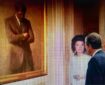
Mother and son confer beneath an image of their late husband and father at the first annual Profiles in Courage Award ceremony, 1989.

Jackie and John talk with President Clinton, both being among his earliest and strongest supporters, 1993.

Following her diagnosis of non-Hodgkins lymphoma, John accompanied her mother to church. Three months later her funeral would be held there.

At Jackie’s Arlington National Cemetery burial, John kissed his hand and then touched it at the gravestone of his father, besides whom his mother was laid to rest.
Categories: The Kennedys


Jackie & The Nixons: Mrs. Kennedy Returns to the White House, With New Images of the Visit
Liz Taylor Meets Jackie Kennedy: Tabloid Fantasy to Chance Encounter & The Only Photos of Them Together, Part I
Liz Taylor Meets Jackie Kennedy: Tabloid Fantasy to Chance Encounter & The Only Photos of Them Together, Part II
To Know Mrs. Onassis: Why Jackie Kennedy’s Life as Art Endures
Hi Carl –
Any idea what the relationship was like between Mr. Onassis and his two step children? What about the relationship between the two Kennedy children and the Onassis children?
As this is the anniversary of Mrs. Onassis’ death, I have always been curious as to why Ari’s name was never mentioned during her funeral?
Thank you and my best to Hudson.
David//Chicago
Thanks David – I actually did write about the relationships of the “blended” Onassis-Kennedy family in a previous article on the website here, part of a series from last fall. As for the second question – I can only speculate and I don’t like to do that – would rather have facts. Hudson is lovingly willful….counter-surfaced the kitchen and ate steak and pie today. Lovely.
Great article as usual. The palace in Honolulu is the `Iolani” Palace.
Thanks for that – corrected. I appreciate it.
I don’t understand why you focused on John and his mother. I really enjoyed it, but why not include Caroline?
Its been said that even were they not related that Jackie and John would have become friends based on their intrinsic personalities – there was a simpatico that was greater than most parents and their adult kids. That dynamic rather than a traditional one made it more interesting for me to invest the amount of time in it that I did. It is also personal: only later, through him when we spoke at the magazine offices, did I learn that his mother, with whom I worked on my first books, had suggested me to him as a writer – certainly showing a professional closeness between them. The anniversary of her death prompted this article because of the fact that he alone publicly announced it. I was also struck by the unusual number of images over the years illustrating the great comfort level they both felt in displaying affection for each other in public – a factor one does not find she shared with others. Lastly, he spoke publicly on many occasions about their relationship which meant the article text would not be largely speculative, which I strive to avoid.
A powerful series of photos – thank you!
Thank you Jim – that process is harder than I imagined….and I always forget that lesson and experience all over again….I always think ‘ah photos instead of words’ will mean less time necessary to do it well. Not true. All the more reason you thought is appreciated.
Another fantastic article Carl. And fyi? John was clutching a loaf of bread because he was going to feed the ducks (geese — whatever the heck they are) at Hyde Park.
xo
@pamelakeogh
Loaf of bread riddle solved! I was hoping someone would know – and of course, you did Pamela. Many thanks for writing.
Hello Carl,
Your pieces about Jackie are always so special….and this one is amazing. I have always wanted to see a photo book done on John and his mother….that bond was so unique.
I am a date freak, so I do have a couple of caption corrections:
-Easter Sunday picture is 1963
-photo with Astronaut Gordon Cooper is 1963
-Hawaiian Palace tour is 1966
-Rose Schlossberg’s christening photo is 1988
I love your work..thank you so much
Jane Wypiszynski
Dear Jane – Really generous of you to offer that observation. I still believe she was one of the most intelligent, creative people to live in the White House and one of the most “subversive” in terms of her management of conveyed complexities to the public in venues easily understood. And I depend on those like yourself who catch details and make the effort to further refine the accuracy of both story text and captions. Thank you very much for that – and your comments.
I see that Christopher Anderson is doing a book on John and his mother. I wish it were you doing it, because his accuracy is not the best. Yours is a matter of scholarship.